12 August 2016

Joni Mitchell—Court and Spark

Joni MitchellCourt and Spark (1974)
Court and Spark—Coming off the pensive, adventurous For the Roses (1972), Joni Mitchell had the world at her fingertips. That album was the fourth in a series of increasingly huge hits, and critics and even other major musicians worshiped her. Roses, while not exactly orchestral, was her most carefully produced album yet. For the follow-up, she sought out an even wider range of musicians who could play even more intricate parts. Court and Spark was teased with the "Raised on Robbery"/"Court and Spark" single, a rock-and-roll A-side that charted respectably (#51 in Canada, #65 in the United States) but failed to make the same impact as Roses' "You Turn Me on, I'm a Radio." This proved to be insignificant, as Court and Spark went on to hit #1 in Canada, #2 in the U.S., and Top 40 in several other countries following its January 1974 release.
The keynote address, "Court and Spark," details the wariness that comes with seeking romance. A street performer has an epiphany that leads him to throw it all away in pursuit of love. Mitchell (or Mitchell as the singer) notes her instant connection with him, but also her apprehension, seemingly both in general and in waiting for the other shoe to drop. "I cleared myself/I sacrificed my blues/And you could complete me/I'd complete you," he promises; Mitchell concludes, "The more he talked to me /The more he reached me /But I couldn't let go of L.A./City of the fallen angels" (with the slick addition of bells in the background), indicating she is not willing to give up her lifestyle fully as her subject has. The smooth, self-deprecating "Help Me," her biggest hit, similarly notes the difficulties of commitment ("We love our lovin'/But not like we love our freedom"). The liberative "Free Man in Paris" is a cheeky tribute to her friend David Geffen (head of her label, Asylum), poking fun at his complaints about working in the industry. "People's Parties" is a short statement on social anxiety and struggling to fit in. It medleys into "The Same Situation," another commitment song that sees would-be lovers striving to reconcile the failings of one another.
"Car on a Hill," in which the singer waits for their lover to come pick her up, suggests the fear and disconnected feelings that come with having a more outgoing partner. The contemplative, symphonic "Down to You" is the album's musical capstone, and is more lyrically broad, examining personal transformation and loneliness. "Just Like This Train" is comparatively less weighty, even contented: "Lately I don't count on nothing/I just let things slide." Its wisdom ("Jealous lovin'll make you crazy/If you can't find your goodness/'Cause you lost your heart") stands in opposition to the uncertainty of the rest of the album; Mitchell confidently relaxes and observes those around her against the semi-metaphorical backdrop of a train ride. The brash "Raised on Robbery," the album's finest moment, is a witty raid on the daily grind in which Mitchell identifies with a prostitute. The sax-twinged "Trouble Child" is about being stuck in life, unable to connect to anyone, romantically or otherwise, and not yet having the strength to move past yourself or listen to advice. Of the rare cover, "Twisted" (featuring Cheech & Chong), Mitchell once explained, "I hope you enjoy your craziness, 'cause it can be a lot of fun" (stage banter from August 22nd, 1974 performance).
Widely regarded as a triumphant success, Court and Spark's only substantive criticism is that Joni Mitchell sold out on it. While it was indeed loaded with more radio-ready songs than its predecessors, Spark is also more heterogeneous in nature and takes more risks than For the Roses, which is arguably her most difficult album to crack. Her previous albums had all ultimately been arranged uniformly as folk albums, even if the instrumentation varied from time to time; on Spark, she ventured fully into jazz for the first time and made a Dylan-esque move by fully embracing rock, if only for a moment. In the process, she made an album with universal appeal that didn't sacrifice her songwriting, which remained cerebral, droll, and piercing.


More Joni Mitchell reviews by The Old Noise:


Song to a Seagull (1968)

Clouds (1969)
Ladies of the Canyon (1970)
Blue (1971)
For the Roses (1972)
Court and Spark (1974)
Miles of Aisles (1974)
The Hissing of Summer Lawns (1975)
Hejira (1976)
Don Juan's Reckless Daughter (1977)
Mingus (1979)
Shadows and Light (1980)
Wild Things Run Fast (1982)
Dog Eat Dog (1985)
Chalk Mark in a Rain Storm (1988)
Night Ride Home (1991)
Turbulent Indigo (1994)
Taming the Tiger (1998)
Both Sides Now (2000)
Travelogue (2002)
Shine (2007)

10 August 2016

The Move—Shazam

The MoveShazam (1970)
Shazam—"Band for hire" could probably have been the Move's slogan from 1968–70. Upon the release of Move (1968), bassist-vocalist Ace Kefford left, and guitarist-vocalist Trevor Burton soon followed after an injury and in-fighting. Three singles followed—"Wild Tiger Woman," which flopped, "Blackberry Way," which hit #1 and saved their career, and "Curly," a respectable hit. However, the sweeter tones of the latter two were not wholly representative of the Move's essence; they were still a rock-and-roll band with some weirdness and a penchant for the occasional classical or R&B crossover. In the middle of this, enterprising lead vocalist Carl Wayne took it upon himself to sell the Move to Starlite Entertainments, who amusingly began to book them in cabaret clubs, which proved lucrative. Cabaret was conducive to Wayne's style, but not so much to the rest of the band; they continued playing regular gigs, and also tried to crack the U.S. market with little success thanks to almost no support from their U.S. label, A&M.
When they returned to the studio to finish Shazam—which had been announced soon after the release of Move—it had become a far different record than was originally intended. Keyboardist Richard Tandy had joined the band after Kefford's departure, but quickly moved to bass after Burton's injury, and when Burton recovered, Tandy simply left the band. Tandy and Dave Morgan were meant to help write parts of a double-LP Shazam, but Morgan only ended up contributing the non-album songs "This Time Tomorrow" and "A Certain Something" (sometimes rendered "Something" or "That Certain Something"). Instead, the single LP ended up being half Roy Wood originals and half Carl Wayne-chosen covers (Mark Paytress, liner notes to 2007 Fly/Salvo CD reissue of Shazam).
By this time, Wood's personality had begun to take over the once-democratic Move. His stage act became more elaborate, much like his more wildly successful contemporary, David Bowie. Where once it was fairly uncommon for he, the Move's primary songwriter, to sing his own songs, Shazam opened with Wood belting out the lumbering "Hello Susie." It had recently been a pop-blues hit for Amen Corner; Wood reclaimed it in his own obscure style. The ironically elegant "I-just-got-laid" "Beautiful Daughter," sung by Wayne, is the album's only straightforward cut, and would have been its single (it ended up having none) had Wayne not left the band. It is preceded and followed by bizarre bouts of chatter, the second of which leads into a reworked "Cherry Blossom Clinic Revisited," which extends into a Looney Tunes-esque, classical music-quoting jam. On their rendition of Ars Nova's sanctimonious "Fields of People," they demonstrate more expertise than on the original before moving on to a five-minute tantric, interpretive passage that simulates Indian music. An emboldened version of the Mann/Weill "Don't Make My Baby Blue" is probably the album's most banal moment, but Tom Paxton's "The Last Thing on My Mind" as a rolling, psychedelic epic is somehow effective.
Usually regarded as the Move's best album, Shazam is probably better described as their best-played album. They were rarely in better form than they were on Shazam's jams, but there are downsides. Carl Wayne, while serviceable, didn't flourish in such a dominant performing role; he wasn't a varied or terribly interesting singer, and his cover choices were not strong. Roy Wood's songs weren't by and large new material, even if they are refined and generally improved, and they're not exactly his best songs—they simply appear to be because of the strength of the overall package. That's where Shazam succeeds, if it does anywhere: it's a good album to have playing in the background and not examine too closely.

21 July 2016

Joni Mitchell—Don Juan's Reckless Daughter

Joni MitchellDon Juan's Reckless Daughter (1977)
"I was the only black man at the party." —Joni Mitchell (The Hissing of a Living Legend, Neil Strauss, October 4th, 1998)
Don Juan's Reckless Daughter—In 2014, the then-president of the Spokane, WA chapter of the NAACP, Rachel Dolezal, generated controversy around the claim that she was transracial. Though it was a hot issue for a time, the public eventually forgot about her, as with most things. People probably also don't remember that Joni Mitchell posed as jive cool-cat Art Nouveau on the cover of her ninth LP, Don Juan's Reckless Daughter.
Cultural appropriation has become a contentious issue in the 2010s, but it's mostly brought up in situations where money or power are at stake—majority groups have been incorporating minorities' musical conventions into their own across time, and because music is purely expression, there are rarely any accusations of wrongdoing thrown around. When Joni Mitchell began to assimilate jazz and world music into her unique brand of folk and pop, it wasn't seen as dubious. For one, she'd already hit the big time both as a songwriter and performer by her first forays into jazz; she'd begun to utilize jazz musicians on For the Roses (1972) only after scoring numerous hits, so it can't reasonably be said it was a move made to capitalize on a cold market (and in fact, her sales only dropped as she moved farther away from white folk music). Two, she seemed to truly identify or at least genuinely seek to empathize with the alien and sometimes bygone cultures she explored in her music. On one of Don Juan's Reckless Daughter's inner LP sleeves, Art Nouveau exclaims, "Mooslems, Mooooslems! Heh, Heh, Heh." It's a phrase so ridiculous one must assume satire was Mitchell's intent, and so it follows that the artist either intended an examination of bias and discrimination or simply did not see the same impassable boundaries between cultures that so many build and perpetuate.
The original Don Juan's Reckless Daughter LP is unusual in that the records were produced with side pairings 1/4 and 2/3. Sides 1 and 4 are more or less typical pop songs, several of which were already parts of Mitchell's live sets, most notably "Jericho," which appeared commercially as early as Miles of Aisles (1974). Sides 2 and 3 are experimental—the extended, impressionist cut "Paprika Plains" and a makeshift suite of disparate styles, respectively. Mitchell said, "This record followed on the tail of persecution, it's experimental, and it didn't really matter what I did, I just had to fulfill my contract" (Biography: 1976-1977 Refuge of the Roads, Wally Breese, January 1998). Whether she meant to be somewhat dismissive toward the record is unclear, but a sizable amount of work and planning definitely went into it. The arrangement of the record sides must be intentional—it could be that one LP is meant to be the accessible one, but it still begs the question of the side numbers. Apparently, the record set is meant to distinguish the second and third sides—the "dream" music, which comes to the artist in the middle of the set, bookended by ego fascinations—as a sort of id manipulation with a cohesive element to it. The listener must change records to reach the middle sides and again to get out of them, suggesting a discrete and centric quality.
A quiet, moaning, atmospheric overture precedes "Cotton Avenue," an ode to nightlife. Mitchell and her army of guitars are accompanied only by drummer John Guerin and bassist Jaco Pastorious, who returns from Hejira (1976) as her primary collaborator. "Talk to Me" seems to lead out of this scene, describing the coming-down from a night out ("There was a moon and a street lamp/I didn't know I drank such a lot/'Til I pissed a tequila anaconda/The full length of the parking lot") but is really about sexual frustration. Mitchell sings, "Any old theme you choose/Just come and talk to me," belting out a laundry list of possible discussion points (as well as a deadly funny Shakespearean aside), both idealizing her subject and criticizing him for his conservatism. The melodic "Jericho" is about apprehension, only loosely fitting into the schema.
"Paprika Plains," the piece that caught the attention of the legendary Charles Mingus, is the main attraction. It's straightforward for the first four-and-a-half minutes—just Mitchell and her piano plus strings—she describes a dreamy version of her memories from a party. The people watch the rain from indoors, and sit in a haze of clashing aromas: "Liquid soap and grass/And Jungle Gardenia crash/On Pine-Sol and beer." "Back in my hometown," she begins again (presumably referring to Saskatoon, Saskatchewan, Canada, but perhaps also an imaginary, idealized hometown from her dream world), "They would have cleared the floor/Just to watch the rain come down." She describes the urbanization of humans ("And they cut off their braids/And lost some link with nature") and eventually glides off into full-on fantasy: "I dream paprika plains/Vast and bleak and God forsaken/Paprika plains/And a turquoise river snaking."
The next portion of the song deals with unspoken imagery tethered to Mitchell's visionary poetry, which is included with the rest of the song's lyrics. She sees herself flying over Paprika Plains in a helicopter, where "Only a little Indian band/Come down from some windy mesa/No women to make them food and child/No expressions on their faces." She wonders why she sees all of it, the disparity between the poverty of the tribe and the "flying machine/Of earth and air and water." One of the tribesmen raises his fist to the skies, and an atomic blast forms over the horizon. Her visions then turn to a beach ball, which becomes Earth. She cuts it with her fingernail to open and reveal Paprika Plains once again. Then, the song returns to its vocal delivery, and she is back at the party, where she finds herself floating back to a nameless individual, hinting at fate and inevitability.
Side three, beginning with the escapist "Otis and Marlena," continues the abstract direction of the previous side; Marlena dreams about her summer getaway "while Muslims stick up Washington" (which had actually happened around the time of the song's release). "The Tenth World" is a Spanish rumba led by Manolo Badrena and backed by other members of Weather Report, Mitchell, and Chaka Khan. Another romantic shuffle, "Dreamland," closes out the side, this time with just the latter two vocalists and a percussion section.
The remaining side returns to more introspective music. The arch, streaming "Don Juan's Reckless Daughter" is the final side opener: an ambivalent self-examination. Mitchell examines her conflicting sides ("Restless for streets and honky tonks/Restless for home and routine") and her confrontation with a version of herself from the past ("Last night the ghosts of my old ideas/Reran on channel five/And it howled so spooky for its eagle soul/I nearly broke down and cried"), anthropomorphizing the days, people, spirits, and even virtues. The jangling "Off Night Backstreet," ironically about a Don Juan, is a highlight, backed by members of the Eagles. Closer "The Silky Veils of Ardor" is a cautionary gloaming folk tale that ties together the stories on the first and fourth sides, while also adding, "But I have no wings/And the water is so wide/We'll have to row a little harder/It's just in dreams we fly."
Don Juan's Reckless Daughter was Joni Mitchell's longest regular release (outside live albums and Travelogue [2002], which contained no new songs), and among expansive record sets, only the best of the best get special attention. It's a daunting task to sit through a double or triple album when there's more than a couple bad cuts. Unfortunately, despite its overall great quality, Don Juan has been mostly forgotten, generally regarded as respectable but also an indulgent mess. Some did not appreciate Mitchell's further retreat from pop and folk music, while others simply could not surmise her intent or appreciate the music for what it is rather than what she could have been doing instead. It doesn't feel right to call the album a masterpiece, but it's one of the artist's most worldly and thought-provoking, important to her evolution, and pleasing to the ear, if flighty—though flighty was supposed to be one of her most celebrated characteristics.

09 June 2016

Led Zeppelin—[Untitled]

Led Zeppelin[Untitled] (1971)
[Untitled]—There are various reasons why writing about Led Zeppelin's fourth album is pointless. It doesn't need promotion—it's already one of the best-selling albums of all time anywhere. Even those who don't own it have more than likely heard something from it, be it the ubiquitous "Stairway to Heaven," "Going to California, "or the singles "Black Dog" and "Rock and Roll," either in their original forms or mangled badly by high school classmates. More than that, however, the album is notable for its continuing popularity; other all-time bestsellers like Meat Loaf's Bat out of Hell or the soundtrack to Saturday Night Fever have faded into relative obscurity, being relics of their time, but the nominal Led Zeppelin IV has more or less retained its significance since its release.
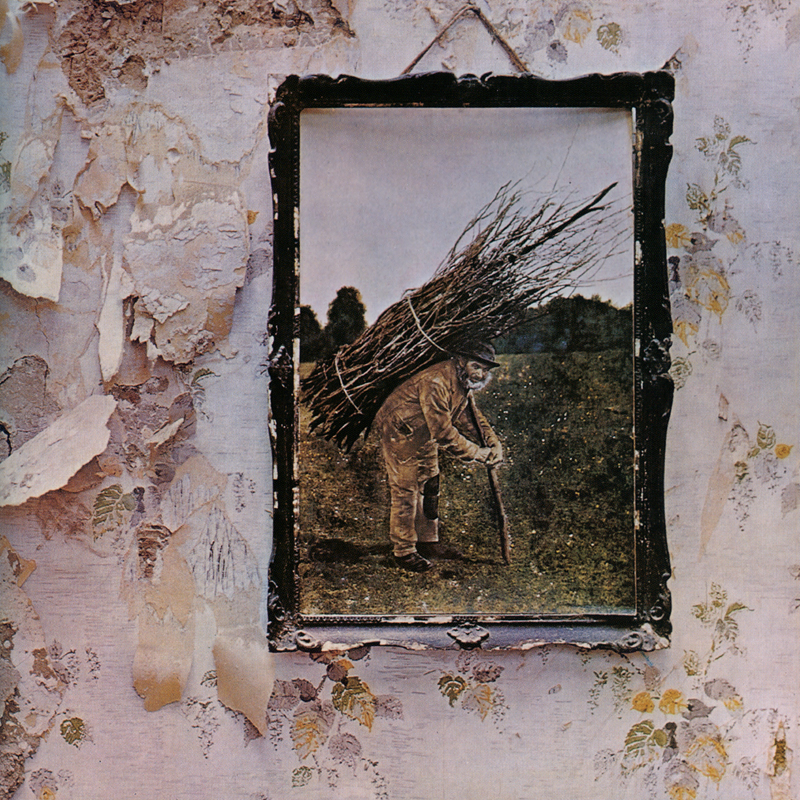
Nowadays, giving a piece of product no title is nothing extraordinary, but when Led Zeppelin did it, it was considered a risk. The Beatles released their eponymous all-white album four years prior, but the Beatles were also the Beatles, and the band's name was nonetheless printed in all capital letters on the front cover. Led Zeppelin's fourth album has nothing distinct on the cover relating to the band, though it has become iconic itself: an antique painting hung against a run-down wall. Fittingly, its songs in one way or another share this arcane quality. The military cadence "Black Dog" is a twisted blues that's hard to count, inspired partially by a black dog whose antics were a source of amusement for the band. The frenetic "Rock and Roll" features an augmented rhythm section with Ian Stewart of Rolling Stones fame (who also played on "Boogie with Stu," which was recorded during these sessions along with "Night Flight" and "Down by the Seaside," all three of which would later appear on Physical Graffiti [1975]) and is made by the always-stellar drumming of John Bonham. It can be seen as a response to the more insipid reactions to Led Zeppelin III ("It's been a long time since I rock-and-rolled").The diacritic "The Battle of Evermore" is the band's most explicit citation of The Lord of the Rings, written on the mandolin (which was first introduced by John Paul Jones on Led Zeppelin III) and supplemented by the singing of Sandy Denny (Fairport Convention).
"Stairway to Heaven," for all that's been said about it both good and bad, probably is their crowning achievement. No matter how overplayed it may be, it's a marvelous three-part suite, even if the first segment is admittedly very similar to Spirit's "Taurus"—but that's only one small part of the song, and the rest of it, from Robert Plant's inspired lyrics to Jimmy Page's astonishing guitar solo, John Paul Jones' arrangements, and John Bonham's steady beat are a mix they never quite equaled again. The plodding, sardonic "Misty Mountain Hop" grates, though it is amusing. The primordial "Four Sticks" was the song that turned into "Rock and Roll" during rehearsals because of Bonham's frustration with the song's meter (it was named so because Bonham played it with four drumsticks), and gets its point across more on abstruse textures than it does its throwaway lyrics. The tranquilizing Joni Mitchell tribute "Going to California" obliquely references her songs "I Had a King" ("To find a queen without a king") and "California." The magnified Delta blues apotheosis "When the Levee Breaks" adequately evokes the sense of doom inherent in the original piece (by Kansas Joe and Memphis Minnie), if turgidly.
A less appreciated aspect of Zeppelin's fourth album is the chirality between its two sides: the related compositions "Rock and Roll" and "Four Sticks," the mandolin excursions "The Battle of Evermore" and "Going to California," and the epics "Stairway to Heaven" and "When the Levee Breaks." It's ultimately an inessential observation to the listening, but it adds to the cohesive, timelessly cyclical nature of the record. Beyond that, it's a masterfully performed and produced album, and the fact that it's been so persistently conspicuous for more than forty years is a testament its excellence.

04 June 2016

Jacques Brel—Jacques Brel et ses chansons

Jacques BrelJacques Brel et ses chansons (1954)
Jacques Brel et ses chansons—Jacques Brel only began writing and performing music in 1952 when he was 23. Before then, his only apparent creative outlet was in amateur theater with friends. Otherwise, his upbringing was highly theological—he went to Catholic school in Belgium and spent most of his spare time as part of a Catholic philanthropic group. After a spot in the military, he began writing songs as a new creative outlet, having developed a relatively late interest in music. Unfortunately, the emotive nature of Brel's performances was not well-received by his family, and when he moved to Paris in 1953, audiences were almost uniformly indifferent and sometimes hostile. However, thanks to the talent agent at Philips who convinced him to move there in the first place, Brel was able to record his debut, Jacques Brel et ses chansons (known sometimes as Grand Jacques or Jacques Brel 1).
The brash "La haine" ("Hatred"), a frustrated lover's harangue, is full of great, stinging Brel lines like "Comme un soldat je partirai/Mourir comme meurent les enfants/Et si jamais tu en mourais/J'en voudrais revenir vivant" and "L'amour est mort, vive la haine/Et toi, matériel déclassé/Va-t'en donc accrocher ta peine/Au musée des amours ratées." On "Grand Jacques (C'est trop facile)" ("Great Jacques [It's Too Easy]"), Brel points out the arbitrariness of absolution ("C'est trop facile d'entrer aux églises/De déverser toute sa saleté") and criticizes the myopic nature of his peers ("Vous ne voyez donc point vos cimetières?") and the heavy-handedness with which they approach love ("Qu'il craque en deux parce qu'on l'a trop plié") while lamenting to himself the seeming pointlessness of his protests and concluding that it's too easy to go through life without asking the big questions. The "Alabama Song"-reminiscent "Il pleut (Les carreaux)" is sung from the point of view of a young man claiming his failure at romance to be out of his control, but "La lune danse pour moi le soir ... et son haleine, immense halo, me caresse." The mock-mischievous "Le diable (Ça va)" (The Devil [It's Fine]) furthers Brel's theme of societal disconnect ("On traite les braves de fous/Et les poètes de nigauds"), effectively deriding "Ça va" as an expression of flippancy. "Il peut pleuvoir" (Let It Rain), by contrast, is a straightforward, concise love song.
"Il nous faut regarder" ("We Must Look") reminds us to look beyond the world's ugliness to see its patches of beauty. The tragicomical waltz "Le fou de roi" ("The King's Fool") is a statement on class, while the cheeky "C'est comme ça" ("That's How It Is") exposes the stagnant lives of the common people, the two songs exhibiting conflicting sides of Brel's worldview. The parable "Sur la place" (In the Square), the best and most nuanced song here, alleges the hardened hearts of the masses.
Jacques Brel et ses chansons is something of an anomaly; by his second album, Quand on n'a que l'amour, Brel was already moving into a wider variety of more lush arrangements. The literary quality of his debut is more often than not on par with his more well-known songs, but it's unique for its minimalist guitar settings and more rustic feel of Brel's stricter cabaret origins. Thus, while it might not be his peak, Et ses chansons is an enchanting, thought-provoking collection—and just under 20 minutes.