Showing posts with label pop-rock. Show all posts

25 May 2016

The Beatles—Please Please Me

The Beatles—Please Please Me
Please Please Me—The farther you get back in the Beatles' discography, the less likely people are to remember it. That's not to say any Beatles album, single, or even outtake can be considered obscure, but while Revolver (1966) Sgt. Pepper (1967) are household names, the pre-Rubber Soul (1965) albums are often considered at least partially inessential. Please Please Me was their first one ever (Introducing... the Beatles and Meet the Beatles! [1964] were the first ones to hit the United States), coming on the heels of the "Please Please Me" and "Love Me Do" singles.
Paul McCartney's dissonant rocker "I Saw Her Standing There" opens the album on a high note, importantly showing early on that the band could write a classic all their own. "Misery," written originally for Helen Shapiro, is one of the greatest sub-two-minute pop songs ever. John Lennon's rendition of Arthur Alexander's "Anna (Go to Him)" and George Harrison's of the Cookies' "Chains" (Goffin/King) are somewhat pointless, but Ringo Starr's of the Shirelles' "Boys" is strangely effective. Lennon offers the album's best token cloying-nonsense number in "Ask Me Why" in spite of that being McCartney's reputation.
"Please Please Me," which Lennon wrote inspired by Roy Orbison and Bing Crosby, and McCartney's "Love Me Do" showcase the two men's early vocal harmonies at their best. "P.S. I Love You," the first in a series of postal Beatles songs that would be continued by their cover of "Please Mr. Postman" and "Paperback Writer," is lovably banal. Bacharach/David/Williams' "Baby It's You" was not the best choice for a Lennon vocal, while the dopey "Do You Want to Know a Secret?" and corny theater piece "A Taste of Honey" weren't good choices for anyone. "There's a Place" features Lennon and McCartney in a pleasing baritone range. Only on "Twist and Shout" does Lennon do a cover justice, mostly thanks to his famously pained delivery from a marathon recording session.
That doesn't sound like a wholly impressive set, and for the most part it's not—"Please Please Me" and "Love Me Do" and their respective b-sides "Ask Me Why" and "P.S. I Love You" were hardly vital parts of the package, having likely already been sought by every patron in England in single form. The remaining ten songs, only four of which were originals, were recorded in a single session, live in studio, and while only maybe half those cuts are notable in most any way, the band's restless drive shines through on the finished record. On the whole, Please Please Me is something of a classic, if an odd one, and it's amazing to think that even in their nascent stages as hitmakers the Beatles were this tight as a band, producer George Martin included.

03 January 2016

XTC—Black Sea

XTC—Black Sea
Black Sea—Recorded under the exact circumstances as their previous album, Drums and Wires (1979), it would be a mistake to say XTC's Black Sea was simply more of the same. It is unmistakably similar in all its superficial details—same band, producer (Steve Lillywhite), studio (Virgin's The Town House), respective recording date, and length (within two minutes)—but more importantly, it also shares its intelligence and musicality. Andy Partridge's brash, satisfying rocker "Respectable Street," which caused a minor controversy over banal concerns (passing mentions of abortion and contraception), criticizes haughty suburbanites. The inspiration came from a nagging, noise-sensitive neighbor of his near Bowood Road in Swindon, where "several of the houses had this very English thing: a caravan—a trailer—in the front garden. And I thought, 'I've never seen those move! They must be like status symbols, telling people 'We could go away, if we choose to'" (Andy discusses "Respectable Street," Todd Bernhardt, February 26, 2007). He explained that much of his material was written in this house during a break from touring the previous album, and despite the suggestion that Black Sea was hurried, the results were better than when Go 2 (1978) was churned out in the wake of White Music (1978).
Colin Moulding's "Generals and Majors," the lead single, is an amusing take on Oh, What a Lovely War! epitomizing thusly: "Generals and majors always/Seem so unhappy unless they've got a war." "Living through Another Cuba," one of Partridge's earliest rants, is a grower, at first sounding repetitive, but features great guitar work; he details the paranoia of living in the U.K. between Reagan's United States and Brezhnev's Soviet Union ("We're the bulldog on the fence/While others play their tennis overhead"). The bouncy "Love at First Sight," which Moulding introduces on BBC Radio 1 Live in Concert as being "about debauchery and things like that," pokes fun at promiscuous young people, complete with choruses of "duh." "Rocket from a Bottle" is Partridge's token earnest boyish-infatuation tune, and the swaying "No Language in Our Lungs" laments failures in communication (best line: "I would have made this instrumental/But the words got in the way").
The lumbering "Towers of London" ("about some masonry"), making use of found percussion, sentimentalizes London. "Paper and Iron (Notes and Coins)" attempts to balance the Christian ideal of simple living with the modern necessity of security in wealth. "Burning with Optimism's Flames" ("our rewrite of 'Joy to the World'") is a fun, jumping album cut, if nonsensical. "Sgt. Rock (Is Going to Help Me)," based around the comic book character (the first of three XTC DC Comics-inspired songs, followed by "That's Really Super, Supergirl" and "Brainiac's Daughter"), is a slightly amusing if ultimately contrived set of lyrics. The excellent, halfway-ironic heavy metal closer, "Travels in Nihilon," named after the book, interprets the title more literally.
Black Sea sometimes feels like the most perfunctory of XTC's early albums. It also features some of their least involved arrangements, but on the other hand, that makes it all the more bombastic. It's more confident than Drums and Wires, a bit smarter, and generally catchier, which are all things that should come from a band as they evolve.

More XTC reviews by The Old Noise:

White Music (1978)
Go 2 (1978)
Drums and Wires (1979)
Black Sea (1980)
English Settlement (1982)
Mummer (1983)
The Big Express (1984)
25 O'Clock (1985)
Skylarking (1986)
Psonic Psunspot (1987)
Oranges & Lemons (1989)Nonsuch (1992)Apple Venus Volume 1 (1999)
Wasp Star (Apple Venus Volume 2) (2000)

17 December 2015

XTC—The Big Express

XTC—The Big Express
The Big Express—One might venture a guess that although Andy Partridge did not miss touring, he possibly missed the big sound of XTC's older records. Mummer (1983) was an insular studio jaunt, a far cry from the drum-heavy sounds of their previous three records, Drums and Wires (1979), Black Sea (1980), and English Settlement (1982). The Big Express, which is followed in sequence by the lighthearted 25 O'Clock (1985, under the pseudonym Dukes of Stratosphear), almost seems out of place today, not just because of its production but its theory of cohesion. In a 2008 interview (Andy discusses "The Everyday Story of Smalltown," Todd Bernhardt, chalkhills.org), Partridge recalled, "I think that at the time of The Big Express, part of me wanted to do an out-and-out concept album about Swindon—my take on the town, my life in the town, and the town's life itself," Swindon being where the principal members of XTC all grew up, including bygone drummer Terry Chambers.
With that in mind, it is worth noting that The Big Express is also the most Andy Partridge-dominated record in XTC's catalog, with only two of its 11 songs composed by bassist Colin Moulding, and somewhat slight ones at that. "Washaway," an additional song of his, was left off; for posterity's sake: Partridge has indicated more than once that the band voted for what went on the records by committee, and Moulding once said about his earlier composition "Ball and Chain," "It wasn't much of a song. I think I'd gone off the boil ... The least favourite of my contributions. I don't think I got it back until Skylarking." However, there is merit to his opener "Wake Up," whose lyrics of the unbearable grind of the rat race hit close to home. It progresses to a climax in which everything but the guitar cuts out and Moulding describes a recurring dream where bystanders watch apathetically as a man dies in the gutter: a simple diversion for the people who he urges to wake up and become more than just drones.
Partridge's punchy sea shanty "All You Pretty Girls" contains one of his best verses: "I think about your pale arms waving/When I see the caps upon the green/And the rocking roller-coaster ocean/Think about you every night when I'm fathoms asleep/And in my dreams/We are rocking in a similar motion." "Shake You Donkey Up" seems to admonish a wife-beater who got his just dessert. "Seagulls Screaming Kiss Her, Kiss Her" is the album's hidden gem, painting perfectly with its visual cues the hesitant awkwardness of romance. It was also amusingly chosen by a Japanese band to be their name, as if they waited to choose the most awkward title possible as inspiration. Forlorn apocalypse ballad "This World Over" imagines the worst outcome of the Cold War, wondering if humans will claim retroactively that "we did it in His name."
The chugging "The Everyday Story of Smalltown," the most explicit of the aforementioned odes to Swindon, is most memorable to outsiders for the power of its key change and fanciful onslaught of kazoos. "I Bought Myself a Liarbird," Partridge's second bird-themed song of the album and who knows how many overall, is about XTC's then-manager. "Reign of Blows" is a somewhat boring take on his once-per-album anti-violence, anti-hate, or anti-racism message. "You're the Wish You Are I Had" is a bouncy love-at-first-sight song (of the real kind and not the lust that Moulding described in "Love at First Sight") that might have been more effective if its words were not so convoluted. Moulding's mediocre "I Remember the Sun" effectively bronzes his childhood, which makes it seem to unwittingly contribute to Partridge's concept. The neurotic "Train Running Low on Soul Coal" sums up Partridge's helplessness and guilt over the band's new direction (because what early XTC album would sit well without one of his paranoid rave-ups?).
The Big Express can be difficult to listen to, mainly because the engineering was subpar. The heavy arrangements were not handled properly, muffling the messages of songs like "Reign of Blows" under a noticeable loss of dynamic range. However, where it hits, it hits hard, and "All You Pretty Girls" and "Seagulls Screaming Kiss Her, Kiss Her" rank as classics to go with a handful of others that solid or at least interesting. The same can be said of plenty other XTC albums held in higher esteem by the general audience.

More XTC reviews by The Old Noise:

White Music (1978)

Go 2 (1978)
Drums and Wires (1979)
Black Sea (1980)
English Settlement (1982)
Mummer (1983)
The Big Express (1984)
25 O'Clock (1985)
Skylarking (1986)
Psonic Psunspot (1987)
Oranges & Lemons (1989)
Nonsuch (1992)
Apple Venus Volume 1 (1999)
Wasp Star (Apple Venus Volume 2) (2000)

09 December 2015

XTC—English Settlement

XTC—English Settlement
English Settlement—Led by majority songwriter Andy Partridge's onslaught of dissonance, XTC did not so much get more abrasive with time as they did expand their sound through an abrasive stratosphere. Generally, this was done with the aid of synthesizers; Partridge was often able to take advantage of particular noises to establish motif. They were still by and large a guitar band, however, so for their fifth album, English Settlement, they tried something simpler: acoustic guitar. It was still a rock album, of course; the acoustic songs were hardly lilting or sensitive in tone, and other instruments characterize the album, such as Dave Gregory's nylon-string classical guitar and Partridge's experimenting with the anklung, alto saxophone, and on the side-three closer, the frog. Partridge later admitted freely that this direction was an attempt to move XTC into more of a studio life, which did eventually happen; the band performed only a handful of concerts following the release of the album before Partridge broke down on stage at the beginning of a set, rarely to perform again.
"We’d been doing it pretty much non-stop for nearly a decade and I was sick of it all: the crap food, the hours stuck on a bus with the same faces and the general soul-destroying tediousness of it. I got it into my head that if I wrote an album with a sound less geared towards touring then maybe there would be less pressure to tour." —Andy Partridge, A Watershed Moment: XTC's Andy Partridge On English Settlement, The Quietus, February 6th, 2002
English Settlement was the only double album of XTC's early career—later on, after Psionic Sunspot (1987), they always had such a dearth of material to record after long spells of nothing in between that they could have filled two LPs every time out—which interestingly led Virgin to pare it down to a single LP for markets outside the United Kingdom. XTC was never a big seller outside the U.K. until Skylarking (1986), so perhaps the label figured they would be even more daunting at the price of a double. It begins on all versions, uncharacteristically, with two Colin Moulding songs; the appropriately circuitous "Runaways" is some kind of comment on the consequences of domestic squabbling, while "Ball and Chain" is a protest song he wrote after Margaret Thatcher took over as Prime Minister and historical buildings in Swindon, Wiltshire, England (the band's hometown) were being demolished. The former is an interesting swirl of half-melodies, and the latter is "Getting Better" as a football chant, which has not aged well on that merit nor its topical obsolescence. Partridge's "Senses Working Overtime" is a celebration of the senses, for whatever that's worth; in an interview with Todd Bernhardt (Andy discusses Senses Working Overtime, December 11th, 2006, chalkhills.org), Partridge stated, "because I blundered into this sort of medieval thing by accident for the verse, I thought, 'I'll roll with it, I'll write kind of medieval words to it, and we'll go for the rhythm as a sort of medieval single little tight drum.'" The winding "Jason and the Argonauts" was written for the myth or the movie, and though pleasing could be accused of going on too long.
"No Thugs in Our House," one of Partridge's best here, is something like his answer to "Making Plans for Nigel," about a scoundrel of a young man whose parents are oblivious to his wrongdoing. The fast-motion-tiptoeing waltz "Yacht Dance" derides the upper class, while "All of a Sudden (It's Too Late)" reflects on the evanescence of life's fixtures rather than simply entropy. "Melt the Guns" is a rant on the United States and its stance on firearms, which is incisive but musically repetitive. "Leisure" notes the decline of human work ethic. "It's Nearly Africa" is a middling jazz-inflected experiment that misses most notably with its lack of relevance to anything; "Knuckle Down" is anti-racist.
Moulding's foreboding "Fly on the Wall" evokes Big Brother, with a coy bridge of "the bit that's in the middle doesn't count." "Down in the Cockpit" has some of Partridge's most devastatingly funny lyrics and is one of his most musical here; the title explains from where woman controls man, saying that they had "the brain to act like the weaker sex." The sprightly "English Roundabout" is Moulding's metaphor for the rat race, and the curious closer "Snowman" is perhaps Partridge's most explicit elegy to his eventually failed marriage—an eccentric cousin to Joy Division's "Love Will Tear Us Apart."
The overall quality of English Settlement is good, but it lacks a true standout. It has plenty of quality songs and a handful of middling ones, especially on the second and third sides, which played all at once is exhausting; there is no climax. Perhaps it's not meant to be played all at once, and in small doses, songs like "No Thugs in Our House" and "Down in the Cockpit" can be considered great workouts. But its scope, represented perfectly by the Uffington White Horse on the cover, was definitely a product of the self-indulgence allowed by their domestic success. It is also retroactively apparent that Andy Partridge's best days as a songwriter or composer were still ahead of him. Nonetheless, it is an intelligent, adventurous collection that's worth the time invested.

More XTC reviews by The Old Noise:

White Music (1978)

Go 2 (1978)
Drums and Wires (1979)
Black Sea (1980)
English Settlement (1982)
Mummer (1983)
The Big Express (1984)
25 O'Clock (1985)
Skylarking (1986)
Psonic Psunspot (1987)
Oranges & Lemons (1989)
Nonsuch (1992)
Apple Venus Volume 1 (1999)
Wasp Star (Apple Venus Volume 2) (2000)

24 November 2015

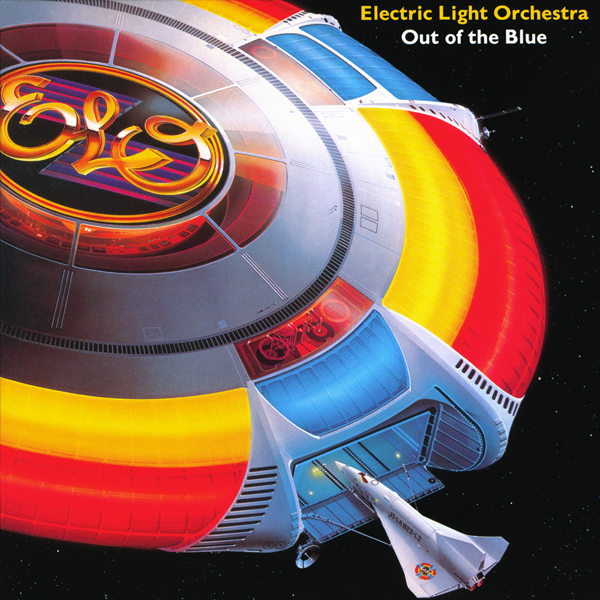
Electric Light Orchestra—Out of the Blue

Electric Light Orchestra—Out of the Blue
Out of the Blue—Divisive though it may be, Out of the Blue was the defining Electric Light Orchestra record set. It wasn't their breakout LP—that was the gold-selling Eldorado (1974)—but it is the greatest testament to Jeff Lynne's talents. ELO are one of those bands where it's hard to say what their best-known song is, but one of them is certainly the revved-up, bipolar blues "Turn to Stone," which always impresses with its call-and-response lyrics. "It's Over" is one of their great album cuts, featuring striking minor-key dips during its chorus. The sweetly obsessive march "Sweet Talkin' Woman" is their peak here—3:50 of symphonic pop bliss (check that chanting in the back of the third verse) and agent of Lynne's underrated humor ("Home run") as well as a great drumming change-up at the end of the song. "Across the Border" accurately portrays the feeling of constant movement.
The dissonant "Night in the City" could have been inspired by Lynne's impending divorce, while "Starlight" sounds like it was written for a child, though Lynne's daughters wouldn't be born for a few years; notwithstanding, it features a notably excellent outro refrain. "Jungle" is the album's cheesiest moment, though as always that's part of the charm, and "joyful harmony" is right. The vocoder interlude "Believe Me Now" sets up the melodramatic closer of the original first LP, "Steppin' Out."
Side three is comprised entirely of the "Concerto for a Rainy Day." which are words that can be heard synthesized at the beginning of "Standin' in the Rain" just after the opening melody. Lynne flexes his prog muscles for the first time in a long while before leading into the movie-music epic "Big Wheels," which is at least more bearable than "Xanadu." The self-empowering "Summer and Lightning" is brighter and more palatable; the celebrated and celebratory "Mr. Blue Sky" is one of Lynne's best melodies. He sneaks in the line, "Hey you with the pretty face/Welcome to the human race," belying a different topic, and closes the song on the comically sentimental note, "But soon comes Mr. Night/Creepin' over, now his/Hand is on your shoulder/Never mind; I'll remember you this way."
"Sweet Is the Night," partially sung by bassist Kelly Groucutt, is one of those songs that probably could have been a hit with a few tweaks; the melodies are great, but they're overloaded with sound effects, the tempo is a little too sluggish, and the lyrics are among Jeff Lynne's most poetic. "The Whale" is a pleasant but mystifyingly out-of-place instrumental. "Birmingham Blues" tributes Lynne's hometown, but with the knowing end verse, "I'll go and stay a while and all the folks I meet /They'll say, 'You won't stay long, you got them travelling feet'/You'll soon be long gone/'Cause boy, you got the rest of the world blues." The love-it-or-feel-ambivalent-about-it "Wild West Hero," if it fails, fails because of its strangely unsympathetic subject matter, which is exactly what it purports to be: "I wish I was a Wild West hero."
It's easy to see why Out of the Blue is not as beloved as its sales might indicate. It sags here and there outside of side one, and the "Concerto for a Rainy Day" wasn't good enough to merit such ostentation. On the other hand, there are nice little moments scattered throughout the record that jump out on each new listen, even on the lesser songs. If not their best, the album may at least be their most fun.

12 November 2015

The Cure—The Head on the Door

The Cure—The Head on the Door
The Head on the Door—The strange disappointment of The Top (1984) was a necessary venture for the Cure. Three Imaginary Boys (1979), Seventeen Seconds (1980), Faith (1981), and Pornography (1982) were all fairly solid and artful or at least charming, though every one was imperfect, and they were all somewhat internally repetitive; the latter three especially were somewhat unvaried. Murkiness was the name of the game, but the songwriting of Robert Smith, Lol Tolhurst, and Simon Gallup wasn't uniformly great, and so it often detracted from the atmosphere. They threw out the book for The Top, and while it produced something far from a masterpiece, the direction they were headed was promising. The optimism of songs like "The Caterpillar" and the non-album singles "Let's Go to Bed" and "The Love Cats" were refreshing after the drugged-up, despairing mess of Pornography.
Between The Top and The Head on the Door, the Cure were joined by guitarist Porl Thompson (who played on Three Imaginary Boys and The Top but never was credited as a full member) and drummer Boris Williams (which freed Tolhurst from the spot to play keyboards full-time). The extra personnel brought new dimensions to an aspect of the band most would not expect: songwriting, which contrary to popular belief was never handled solely by Robert Smith.
The bright, polyrhythmic "In Between Days" was their best song to date, and the first song since Three Imaginary Boys where the Cure actually sounded like a band—also note the recurrence of Smith's "feeling old," to be compared with "I Want to Be Old." The unsettling dream "Kyoto Song" hooks the Cure's trademark grotesquerie with keyboards like they never did before, helping them make the transition from post-punk to new wave. "The Blood" was one of the first songs to diversify their sound, adding flamenco guitar to the mix; "the blood of Christ" refers to an exotic wine. "Six Different Ways" is a cutesy keyboard-led piece with elements reused from Siouxsie and the Banshees' "Swimming Horses" during the brief period in which Robert Smith was a member of that band. It was one of the first truly saccharine moments for the band that were generally disowned by the fans of gloomier goth music, but it showed that when they wanted to, they could command major-key melody with ease.
"Push" is excellent, quintessential post-punk. "The Baby Screams" forecasts "Lullaby." Radio favorite "Close to Me" is a trademark Cure song where the listener doesn't know if it's a love song or a nightmare. One must wonder if Smith or someone was referencing the basic nature of the dissolving-relationship song "A Night Like This" with the line, "The most gorgeously stupid thing I ever cut in the world," although "Screw" is definitely the album's throwaway. "Sinking" more closely resembles the following three albums, unwittingly foreshadowing the water tones that were all over that period.
Although The Head on the Door has neither their best song nor a plurality of their best, it is the Cure's most consistent, tightest album. It was less drudging than their early period and less overwhelmingly indulgent than the albums that followed, even though their best individual moments were yet to come.

25 October 2015

XTC—Mummer

XTC—Mummer
Mummer—The second phase of XTC's career—arguably their defining one—came about due to something almost unheard of in the world of popular music: stage fright. They had been playing for around ten years before Andy Partridge suddenly broke down on stage in 1982, the tipping point being withdrawal from Valium that had been helping him deal with the stress of life in a touring band (Partridge says via Twitter that memory loss and limb seizures were worse aspects of his withdrawal). These facts are well-ingrained into the band's legend, and the incident helped to usher in a new era with a different approach.
English Settlement (1982), though eclectic, was still very much the work of a rock band, with Terry Chambers' drums still mixed in front and generally spare arrangements. Mummer would be the last album to feature him, and only on the first two songs at that; a founding member of the band, Chambers found himself in a tough spot with many of the band's new compositions not being conducive to his straightforward style of drumming. Peter Phipps from Gary Glitter's band played on the other eight songs, as he would on the following album, The Big Express (1984). Ironically, the sounds that open the album on "Beating of Hearts" are Chambers' drums, with Partridge's message summed up by the line, "For a heart without love is a song with no words/And a tune to which no one is listening." Bassist Colin Moulding's scathing "Wonderland" juxtaposes its sugar-sweet melody and synthesized beats with a criticism of someone who is "caught in [their] superficial, non-existent, fairy story/Wonderland." Partridge opined in the notes to Coat of Many Cupboards, "I think this is one of Colin's more beautiful melodies, and so complete, that my only suggestion to help it on its way, was the addition of tropical bird sounds for the finished article."
The idyllic "Love on a Farmboy's Wages," which by some accounts was the straw that broke the camel's back for Chambers due to its stranger rhythm (Partridge tweeted the real reason was "an emotional ultimatum by his new wife"), may be one of Partridge's veiled references to life as a professional musician ("People think that I'm no good/Painting pictures, carving wood ... But the only job I do well is here on the farm ... And it's breaking my back"). The catchy and hilarious "Great Fire" ("I'm animal and panicking") continues Partridge's ongoing fascination with avian creatures as he imitates a bird's cries with the saxophone. Moulding balances out Partridge's clumsy-love with "Deliver Us from the Elements," which is something like a green or naturalist anthem and fits well with Moulding's general political aesthetic or is perhaps reminiscent of, say, The Kinks Are the Village Green Preservation Society.
Partridge's ghoulish "Human Alchemy" is one of his great forgotten songs, which ostensibly looks back on the slavery imposed on native Africans by whites, but might also be a coy reference to record companies' exploitation of black hitmakers ("To turn their skins of black into the skins of brightest gold," or that is to say, a gold record). The simpler "Ladybird" sounds like a song about a fleeting romance that could never be, though it predates Partridge's infamous, up-and-down relationship with Erica Wexler (later the subject of "Seagulls Screaming Kiss Her, Kiss Her" from The Big Express and "Another Satellite" from Skylarking [1986]). The lamentful yet pejorative "In Loving Memory of a Name" is one of Moulding's smartest songs, striking at the banality of surrendering propriety to the military ("Covered in moss/You may have died for your country/Forgotten not lost/You're laid to rest where you're wanted"), ultimately being reduced to "a name," and the indoctrination associated with Christian society ("The sermons attended when you were young/Still echo round these churchyard walls"). "Me and the Wind" is Partridge's token end-of-toxic-relationship song; in the notes for Fuzzy Warbles Volume 5, he noted that "Lots of you seem to think that this song is about Terry Chambers leaving XTC. I can see your logic. Words like ‘snare,' ‘stool,' ‘imprisoned in your drumbeat’ ... Now you've got me doubting my own intentions." "Funk Pop a Roll" is an arch harangue of the record business, which he says is "a hammer to keep/You pegs in your holes" and "Big money selling you stuff that you really do not need," while admitting to the grave notion that he's "already been poisoned by this industry."
A common criticism of Mummer is that its songs are obscure, which is true—it's easy to miss the irony of songs like "Wonderland" and "Funk Pop a Roll" on a casual listen—but that's also the point. A mummer is a person in disguise who puts on a play with dualistic themes; the band can be seen wearing the traditional shredded-paper costumes in the album's inner sleeve. Mummer is a rich album from start to finish, with the exception of some overcooked Partridge moments on side B, but that's par for the course, and never before it did XTC so concisely and beautifully achieve their vision.

29 June 2015

Blur—The Great Escape

Blur—The Great Escape
The Great Escape—After releasing a sensational hit that would eventually be certified quadruple-platinum, most artists would be content repeating the formula. On the surface, Blur did just that after the era-defining Parklife: its follow-up The Great Escape generated four even more successful singles (and an additional one in Japan). However, it has come to not be as fondly remembered as Parklife; lead singer Damon Albarn himself has said The Great Escape is one of two bad records he's made, calling it messy and, by way of comparison to another band's work, empty.1 It went toe-to-toe in its own time with Oasis' (What's the Story) Morning Glory?, which by virtue of its greater success perhaps proved fans were satisfied with one volume of Parklife's quirky brand of Kinks-cum-Smiths pop.
The Great Escape saw Blur paying homage to a wider range of music greats and was more bipolar and abrasive than its predecessor; while Albarn's claims of messiness are not unfounded, it also has some unjustly-forgotten material. Bassist Alex James quipped at the time that "Darklife" was among the rejected album titles,2 and while he may have been joking, it is not at all a misnomer. The songs are much more trenchant and critical than Parklife's, which had its share of lament and observational wit, but was hardly hostile. The opener "Stereotypes," for example, is a blaring mishmosh of synthesizer and guitar that lines dry lyricism of wife-swapping. As one of the less-rewarding songs, it is peculiar that it opens the set, but it makes more sense framed as an open disdain of continuing the Parklife sound. "Country House" would have been the more obvious choice, considering it was the lead single, hitting #1 over Oasis' "Roll with It" while taking a shot at the same band ("He's got morning glory/And life's a different story") and it is truly a great pop song; it marks a return to the band's traditional alt-rock sound of Leisure and Modern Life Is Rubbish—which, through the annals of time, has been obscured by the enduring popularity of Parklife, which often is viewed as representative of Blur's overall sound. The only difference here is the incorporation of a horn section, signaling one or more band members' fascination with ska.
"Best Days" is a dreary, minor-key affair, and one of the best, incorporating variations on A chords in its chorus' interesting progression (the colorful CD booklet, in fact, denotes every one of these chord changes throughout the album). "Charmless Man" is a more straightforward rock song, but a great one, sometimes purported to describe Suede frontman Brett Anderson, ex-boyfriend of Albarn's then-girlfriend, Justine Frischmann. "Fade Away," sounding almost like fun-house music, is a misanthropic snapshot of people with empty lives that only become emptier. "Top Man" is the most obvious ska tribute, borrowing liberally from Fun Boy Three's "The Lunatics (Have Taken over the Asylum);" "The Universal" began life as such—a ska song for Parklife—but ended up a watershed for Blur, marking their most notable early use of strings, and turned into a beautiful piece, with an excellent climax featuring Albarn snarling, "Every paper that you read/Says tomorrow's your lucky day/Well, here's your lucky day."
"Mr. Robinson's Quango" is a tart, raunchy number that fires shots at nonspecific political figures. "He Thought of Cars" is a markedly obvious David Bowie tribute with half-referential, half-nonsensical lyrics and winding, spacey music (cf. "The Bewlay Brothers"): curious, but somewhat useless; "It Could Be You" instead borrows conventions from the power-pop era, which better suits Blur. "Ernold Same" features then-MP Ken Livingstone and is usually said to reference Pink Floyd's "Arnold Layne," but possibly relates better to the Jam's "Smithers-Jones." "Globe Alone" follows "Jubilee" from the last album and foreshadows the further pop-punk styling of "Song 2" and "Chinese Bombs." Albarn turns autobiographical on the seductive, anagrammatic "Dan Abnormal" (subtitled "The Meanie Leanie"); worth noting is the fact that two Elastica albums credit a keyboard player named "Norman Balda." "Entertain Me" is reminiscent of Bowie's Scary Monsters. Buried at the end is "Yuko and Hiro," one of the sweetest songs Blur had yet recorded, with a sung Japanese verse, altogether probably a nod to Blur's popularity in that country.
There is truth to Albarn's remark that The Great Escape is messy—it runs almost an hour long, and a good duration is devoted to somewhat pointless if often pleasant mimicry—but it is certainly not, as he claims, bad. Its singles are arguably the best they ever cut, and the roomy rock sound, unique synthetic tones, and generally fitting string and horn parts were welcome changes for Blur. It's no masterpiece, but it has enough strokes of genius to warrant its addition to any fan's collection.


1 digitalspy.com/music/news/a46469/damon-albarn-criticizes-blur-albums.html#~pgE9JFzZBQEmvF
2 moozine.co.uk/blurcentral/albumsthegreatescape.htm

16 June 2015

Squeeze—Argybargy

Squeeze—Argybargy
Argybargy—It's a tall task for a singles band to put together a respectable album. It has proven difficult since the inception of the album format, and some artists, no matter how talented, aren't best represented by it; they may be more focused on individual compositions, in which case not every one will be a gem, but they still need to fill an LP. This is definitely true in the case of Squeeze, whose first two albums, Squeeze (1978) and Cool for Cats (1979), were decidedly uneven. One would expect the approach might be different with their third album, Argybargy, but there really wasn't—the songs were just better, bullet for bullet.
Like Cool for Cats, Chris Difford's lyrics recount seemingly prosaic stories and events, even touching on observational humor. "Pulling Mussels (from the Shell)" is the successor to Cats' titular closing piece, picking up right where Squeeze left off. Where that album roiled with camp, plodding on every other cut with a sense of limited novelty, Glenn Tilbrook's Argybargy melodies are prettier, finding better uses for keyboardist Jools Holland's whimsical playing. "Another Nail in My Heart" is the greatest pop single of its time, immaculately crafted with its cleverly-misplaced bridge: the greatest snapshot of the band's talents. "Separate Beds" is a more innocent boy-girl song than is typical for Difford, and so it is knowingly understated, but still sweet. What really sets Argybargy apart from its predecessors—which despite their faults, had singles as good as anything Squeeze ever did—is songs like "Misadventure," which combines the colorful imagery of "Take Me I'm Yours" with the playfulness of the otherwise-valueless "Touching Me Touching You." Similarly, "I Think I'm Go Go" is an upgrade on "The Knack," utilizing more of the band's strengths where before they were flat and uncharacteristically minimal.
"Farfisa Beat" is the only real throwaway, a dismally catchy piece of nonsense that was somewhat insultingly released as a single in select European countries. Welcome for its dynamic interplay is "Here Comes That Feeling," Difford's esoteric, intrusive thinking that underpins many of his stories, much like contemporary Elvis Costello. "Vicky Verky" is a transparent follow-up to "Up the Junction," bordering on self-plagiarism but ultimately pleasing with its uptempo keyboard rush. "If I Didn't Love You" was Squeeze's minor breakthrough on U.S. radio, more straightforward and seductive than the playful pub poppers that made them popular in their home country of England. Third vocalist Jools Holland takes on the effervescent "Wrong Side of the Moon," which is a solid tune despite its ostensibly careless nature; "There at the Top" somehow comes off as more questionable by comparison, bordering on derisive.
It should be said that Argybargy feels slightly underweight, and this is no coincidence. Squeeze originally recorded 14 songs for the album that A&M trimmed to 11; "Someone Else's Heart" would be reused for East Side Story the following year, "Funny How It Goes" was effectively the title song under the album's original name (It's a Funny Old World), and "What the Butler Saw" was instead used as the b-side to the single of "Pulling Mussels (from the Shell)." This is unfortunate, as the three bolster the set—fortunately, modern releases of the album include them and they are otherwise easy to find. Even without them, however, Argybargy is an impressive pop record with superlative material, and for Squeeze it became their first LP that was truly worth owning.

10 June 2015

Todd Rundgren—Liars

Todd Rundgren—Liars
Liars—Never one to compromise, Todd Rundgren always had an inherent proclivity to detours. What set him apart from kindred spirits Frank Zappa and Neil Young was an enduring fondness for radio pop, rendering him a more self-effacing David Bowie than the former two. But again, Rundgren is his own man, and he was also more on the low-concept side of things: he liked to form bands—he liked the abstract of colluding with a band—he put sound before story (or anything, really), and any attempts at thematic cohesion were done for effect, such as the extemporaneous fourth side of Something/Anything? (1972) or the avant-estrangement of A Wizard, a True Star (1973). Given this, Liars appears to be dressed more like a Roger Waters brainchild:
"All of these songs are about a paucity of truth. At first they may seem to be about other things, but that is just a reflection of how much dishonesty we have accepted in our daily lives [...] The fact is, we are terrified of the truth." —Liner notes of Liars
Elucidating meaningfully for a rare moment, Rundgren heralds just his second bona fide concept album after Healing (1981). There was the strange mixed media project No World Order (1993), the amusing bossa nova makeover With a Twist... (1997), and the experimental voice-manipulation of A Cappella (1985), but Liars is most similar to the 1989's Nearly Human. An admirer of genuine passion in art, Rundgren recorded Human with a number of authentic figures in soul music, namely Bobby Womack, and came up with a product that, essentially, is truthful. Whether he intended this faithful music to be a statement or just simple artistic expression is up for debate—probably the latter, if bets are on the table—but Liars pulls no punches: it's a statement.
Aside from the aforementioned passage, Liars is sparsely furnished; the jacket shows Rundgren dressed as the Easter Bunny, who is a notorious lie of sorts; the photo itself a counterfeit candid. The song titles are mostly one word, non-descriptive, very Pearl Jam, with all of it combining to make clear the listener must spin the disc to get any real sense of the music. Liars sounds distant and roomy as the effective overture "Truth" pulses along: "I gotta find the truth/If I lose my mind, well I don't care." "Sweet" is about freeing oneself from societal pressure and being true to oneself set to a glassy, synthetic groove. "Happy Anniversary" is one of the best, most original cuts on the album; Rundgren uses a soft verse/hard chorus approach to explain the lies children are told about the opposite sex and how it forever affects the way they view relationships. More pointed is "Soul Brother," where Rundgren testifies against the rap game and what he sees as a lack of soul compared to the music that influenced him.
"Stood Up" has lyrics more winding and cryptic than the rest; it is more notable for its musical excellence, inflected with almost a Middle Eastern-type folk sound and impressive natural phrasing of its words. "Mammon," of course, is the attack on the profit-seeking side of religion, specifically American Christianity (or perhaps a similar institution), echoing Nietzsche almost verbatim. Then come the twin time-tales "Future," the promise of a better tomorrow that never comes, and "Past," about failing to accept what has changed in one's relationships—they are not as concise as "Pastime Paradise," but like the rest of the songs they are effective mood pieces. "Past" leads into "Wondering," featuring Liars' best hooks, but also some of the least substantial lyrics. "Flaw" is similarly gripping, a song that grows on the listener, layered with ideas about not being able to compromise in a relationship that is mostly perfect; the singer cannot continue with his love interest because their fatal flaw is, of course, untruthfulness.
Rundgren continues to examine the confounding nature of the spiritual, in this case the eponymous "Afterlife," observing that the great beyond seems to have ever-increasing standards of admission and also the idea of whether life after death can really be better than that which is corporeal; "Living" uses this same subject as a metaphor, but turned inward, as he puts the onus on himself as the singer to question whether he's "living a lie" with his unspecified companion. The penultimate "God Said" is the true confessional that eluded Rundgren for much of his career, as he asks why the enlightenment that apparently comes to others has evaded him; daringly, he speaks as God Himself, urging his followers to "get over [themselves]," taunting those who seek to win God's favor, or perhaps accusing himself of the same misguided actions. Liars is then put to rest with the awesome marquee "Liar," a five-minute drum-and-synth attack that is nothing if not potent catharsis.
Todd Rundgren's contemporaries, such as the individualistic Scott Walker, are often described as having a period where they lost themselves; while this does not describe Rundgren, there was a long stretch of time where his experimentation often obscured his basic musicianship. Liars is the point where he achieved the best balance between these aspects. The sprawling, tantric collection is his best in two decades. It seems overlong at a glance, and in fact Rundgren went beyond his usual scope with more than seventy minutes of music, but the songs are layered, the philosophy is complex, and his craft is as admirable as it's ever been.

05 June 2015

Fall Out Boy—American Beauty/American Psycho

Fall Out Boy—American Beauty/American Psycho
American Beauty/American Psycho—They say history repeats itself, and with the advent of Fall Out Boy's sixth album, that adage has been proven veritable. Where Save Rock and Roll was the distorted mirror image of Folie à Deux, coming out on the other side of fame, American Beauty/American Psycho is a return to the brand of Infinity on High. A welcome change here is certainly the lack of histrionics, though the bombast persists with mixed results.
American Beauty/American Psycho is the classic tale of a band trying out its new bells and whistles. It stands alongside Rush's Permanent Waves, KISSDestroyer, and Green Day's American Idiot as an instance of established rockers opening up their sonic landscape; unfortunately, the results of these experiments don't always equal a good recording—as always, the core songwriting must be strong, which it is more often than not in the case of Fall Out Boy. Albums on the cusp of a new beginning are sometimes given dubious qualifiers like "transitional," but for Fall Out Boy, there should be plenty of oil in the machine; they had already shaken off the dust with Save Rock and Roll two years earlier following a relatively active hiatus for all its members.
"Irresistable" kicks off the album with an unfortunate horn riff, but ultimately gets to the point with haste, unfurling into a respectable if over-cushioned opener. Title cut "American Beauty/American Psycho" is more typical of their usual sing-a-long pop-punk—the least successful single, though certainly not the worst, but it does bring attention to Pete Wentz's increasingly trite lyrics. "Centuries" is the most celebrated single, and is more Patrick Stump than any other band member: cries, chants, and claps that tend to grate, over-produced, but not bad lyrically. "The Kids Aren't Alright" is better, with excellent harmony and less layers of superfluous arena-rock noise—not that arena-rock in and of itself is bad, but Fall Out Boy have long fallen victim to the idea that trying to recreate the sound in the studio is favorable rather than letting the actual live performances speak for themselves. "Uma Thurman" is the album's one successful meshing of the band's big sound with pop-culture jambalaya, as the sample of The Munsters' theme song is just plain excellent as its basis.
"Jet Pack Blues" is forgettable, sounding like the shriveled Siamese twin of "Centuries." "Novacaine" ends up being one of the best songs on the album because of the all-too-welcome distortion; it's a lo-fi crawler that, because of its essential nature, complements the dynamics that are ever-present in Fall Out Boy's music. "Fourth of July" should have stayed the soppy singular phrase as which it likely began life. "Favorite Record," on the other hand, is a fairly effective meta-retro love song that assures the band isn't disdainful of its roots; "Immortals" is the lyrical highlight: a self-aware double entendre combining the sarcastic relationship song of From Under the Cork Tree and prior with a observation on fame. "Twin Skeleton's (Hotel in NYC)" sounds more like contemporary survivors and one-time collaborator Panic! at the Disco. It's something of an anticlimactic closer, but it's respectable.
Beauty/Psycho has some of the right ingredients, but when they put it in the oven, the edges burned a little. It takes the hip-hop approach of having no less than six producers, but the group seems to have forgotten they play rock, which prides itself on its instruments first and effects second. Their vision doesn't afford the experimentation, but when they build on what once made them great, the results are promising. The album is altogether no better or worse than Save Rock and Roll, but given the times, Fall Out Boy need to either try something different or simply write better songs, or they risk falling into the bargain bin.

21 May 2015

Nick Lowe—Jesus of Cool

Nick Lowe—Jesus of Cool
Jesus of Cool—Pub rock was dying, and so would Rockpile. Co-leader Dave Edmunds would continue in the traditionalist rock and roll strain for a number of years, while principal songwriter Nick Lowe would make more adjustments to his approach. But in Rockpile's '70s heyday, the band's output would already exemplify these differences. Edmunds' albums featured some Edmunds/Lowe or Billy Bremner compositions but mostly consisted of rock and roll or country covers; Lowe's were almost all originals or written by contemporary musicians. Jesus of Cool, known in its U.S. incarnation as Pure Pop for Now People, lives up to its tongue-in-cheek title, delivering a litany of sarcastic but utterly joyful could-be, would-be hits.
Radar Records, a subsidiary of Warner, was founded in 1978; Nick Lowe had its first single, "(I Love the Sound of) Breaking Glass"/"They Called It Rock." He and his manager had jumped ship from Stiff, where Lowe had recorded that label's first single, "So It Goes"/"Heart of the City," and EP, Bowi. If it sounds like the confusion among labels and legal stipulations are petty, Lowe probably agreed. "Music for Money" explicitly attacks the commercialism in rock music of the time, as well as the excessive drug use and promiscuous sex in the scene. At first glance Lowe and his song appear to herald straight edge culture, but the tone suggests more of a simple observation. "(I Love the Sound of) Breaking Glass" is a delightful pop tune that is perhaps another nod to Low, after Bowi had already referenced David Bowie the previous year—though the booklets to The Doings (1999) and the 2008 reissue of Jesus of Cool stipulate respectively that Bowi title may have been the label's doing and that Lowe's "Breaking Glass" is "an ode to a trashed dressing room."
"Little Hitler" is a nuanced criticism that could be directed at any number of people or groups, but beyond that is quintessential Rockpile. Dave Edmunds delivers excellent backing vocals and country-inflected acoustic guitar underscored by Lowe's melodic bass lines. Friend, label mate, and frequent collaborator Elvis Costello would record "Two Little Hitlers" on the Lowe-produced Armed Forces later the same year. "Shake and Pop" is another criticism of the money-making aspects of the music scene, not technically included on the U.S. release but it does appear in the cleaner form of "They Called It Rock," which is done more in Edmunds' style than Lowe's. "Shake and Pop" ends up being the more effective of the two because the ragged instrumentation better paints the picture of Lowe's vision of music hell. "Tonight" is one of Lowe's trademark impish serenades and goes hand-in-hand with non-album single "American Squirm," which can be considered the bridge between Jesus of Cool and Labour of Lust (1979). That single would also feature Elvis Costello and (most of) the Attractions as his backing band; the B-side was Costello's "What's So Funny 'Bout (Peace, Love and Understanding", written by Lowe and originally recorded by Lowe's first band, Brinsley Schwarz.
"So It Goes" is the killer app here, a four-chord attack performed with such fire by Lowe and Rockpile that it's strange to think "Reelin' in the Years" by Steely Dan was its likely basis. Lyrically it is one of his most cerebral, based in the themes of Slaughterhouse-Five, while performance-wise he shows just how good he can be on the electric bass. "No Reason" is its low-key cousin, probably the plainest song on the album but still welcome for its organ-twinged groove. The influence of Jim Ford can be heard when compared to the following "36 Inches High." Lowe partially makes Ford's country original his own, presenting it as more of a peculiar, distorted march, which does seem to fit the subject matter. "Marie Provost" is the partially true story of silent film actress Marie Prevost and her death. It suffices to say that only Nick Lowe could turn a lurid, sorrowful account into an uplifting three-minute jewel.
Lowe seems to sum up his feelings on "Nutted by Reality," a good companion to "So It Goes" that reads like a quaint allegory. A live version of "Heart of the City" ends the original LP, which is probably not superior to its studio version but is by no means offensive. The U.S. release instead featured the latter, as well as "Rollers Show," seen variously as either a partial tribute to or a shot at the Bay City Rollers. It was a sequel of sorts to "Bay City Rollers, We Love You," Lowe's attempt to distance himself from his then-label.1 Ironically, it became popular in Japan where the Rollers were held in high regard; "Rollers Show" was probably included on Pure Pop for Now People with similar hopes of it being a paradoxical hit.
"The Japanese kids who were all Rollers fans, they had no idea I was taking a rather sort of jaundiced view of their heroes, you know." —Nick Lowe, 2007 interview
A hit but not a hit, Jesus of Cool spent thirty years without a reissue outside the U.K. along with much of Nick Lowe's catalog. It was the crossroads between time-honored rock and roll, U.K. punk, and new wave, with Lowe being the central figure in much of what spawned these movements. But more importantly, the music is just plain terrific, and if there's a message to be heard here, it's a plain one—beyond the posturing and excess, the contracts and legal issues, the music itself is the important thing.


1 http://dangerousminds.net/comments/bay_city_rollers_we_love_you_nick_lowes_secret_musical_love_letter

18 May 2015

Todd Rundgren—Something/Anything?

Todd Rundgren—Something/Anything?
Something/Anything?—A double album of pop music is almost a contradiction in terms. In the 1960s, an album was more of a brand than it was a work of art. Record companies teased the public with a 7" single and the promise that if they bought the album, they could expect more of the same. Many acts found that they could not produce enough quality music at one time to fill a long-player, a format which, at least initially, was more commonly used to compile existing recordings, such as that of an musical, live performance, or studio odds and ends. It wasn't until 1955 that multi-track recording was developed and 1957 that the mass production of stereo LPs became viable. That opened the door for technophiles like Todd Rundgren to enter the studio and have more complete control over the specifics that made it onto a record.
By the time Rundgren started recording Something/Anything? in 1971, he could do these things from the comfort of his home. He was afforded this luxury by his previous success as part of the bands Nazz and Runt, the latter of which was so heavily under his leadership that its two LPs (Runt and The Ballad of Todd Rundgren) are retroactively considered Rundgren solo albums. But when the term "solo album" is used, it usually means there were other musicians involved in the recording, if not the songwriting; Something/Anything? is the real deal, with Rundgren playing every instrument and producing the album himself—apart from side four, which was recorded with pick-up bands and features some covers.
Todd Rundgren is not someone who submits to ego concerns, admitting to being "pretty overbearing to deal with"1 and prefers to mastermind his releases, though he would go back to using session musicians on many later efforts. He also lets his influences be known, as on the first song and premier single "I Saw the Light," echoing the previous year's "It's Too Late"/"I Feel the Earth Move" from Carole King's Tapestry. Recorded by Rundgren in "all of 20 minutes,"2 it shows this in its simplicity but somehow transcends this in its humble arrangement, not daring the listener to find fault with it. "It Wouldn't Have Made Any Difference" is more nuanced in its chord changes and is a sparkling ballad that also impresses with its irregular vocal patterns. "Wolfman Jack" is an exhilarating tribute to the disc jockey of the same name, which upon its release as a single more than two years later was remixed with Wolfman Jack himself performing the opening lines. "Cold Morning Light" takes it down several notches to a pretty AM radio-flavored pop tune that could have fit alongside "The Ballad (Denny & Jean)." "It Takes Two to Tango (This Is for the Girls)" speaks for itself: a self-empowering seventh-chord anthem: typical musically for Rundgren. Side one—which it should be known the liner notes say is "A bouquet of ear-catching melodies"—closes out with the saccharine, downtempo organ crawl of "Sweeter Memories."
The second side ("This is the cerebral side") has arguably the most experimental material of the four. It is easy to miss the humor of "Intro" on first listen as Rundgren speaks about audible problems that arise during the processing of an album, challenging the listener to "find the sounds on the record." The following "Breathless" makes use of of these noises to create an instrumental jingle backed ironically with a breath track. "The Night the Carousel Burned Down" teeters on the possibility of being a real story ("My first movie score. Unfortunately, there is no movie to go with it."). "Saving Grace" and "Marlene" are more traditional than the rest of the side while the latter was probably most notable as the B-side to "I Saw the Light." "Song of the Viking" is a strange but welcome inclusion that is a faithful shanty possibly with some degree of metaphor. "I Went to the Mirror" closing out the first LP is the most drug-like song here, but also an interesting observation on fixating on smaller details ("In fact the last song is so cerebral it's almost embarrassing.").
"Black Maria" is one of the heavier and more involved songs in the set, with an almost-Led Zeppelin blues-rock sound to it (Side three: "The kid gets heavy."). "One More Day (No Word)" is a gem, styled like a romancero with an excellent arrangement ("... about people with all the time in the world. What a drag"). "Couldn't I Just Tell You" has been rightfully hailed as a power-pop classic, and Rundgren knew it ("The hits just keep on coming."). "Torch Song" is everything it purports to be. "Little Red Lights" is perhaps the least immediately appealing song cut for the album, but it is interesting in its method of construction meant to resemble a car changing gears.
Side four is "A Pop Operetta," "a series of songs with sing along choruses" designed to be spontaneous (if that makes sense). However, "Overture  My Roots: Money (That's What I Want)/Messin' with the Kid)" is actually a pair of 1966 live recordings by pre-Nazz Rundgren groups Money ("Performed by a group of the same name") and Woody's Truck Stop respectively. "Dust in the Wind" is future Utopia member Moogy Klingman's song and a solid one that stands tall with Rundgren's. "Piss Aaron" works despite its strange subject matter: high school students pissing in the halls and puking over egg sandwiches. "Hello It's Me," the most enduring song from Rundgren's catalog, dates back to Nazz when it was recorded as a stripped-down psychedelic tune. Here it's delivered with fuller instrumentation and female backing vocals, giving it new life.
On "Some Folks Is Even Whiter than Me" "the kid waxes jive and breaks into a message song a la New Tempts" and somehow comes out smelling like a rose: Rundgren's studied and earnest delivery offsets his overstepping his boundaries as always. "You Left Me Sore" is made better by the note from the booklet: "The company's new president [...] has convinced the kid to write a public service kind of message song to hip people to the dangers of V.D." A possible candidate for best song in the whole collection is "Slut," featuring Eddie Olmos on backing vocals; though demeaning at first blush, it is a first-rate horned-out rocker that channels the Rolling Stones without borrowing from them.
Something/Anything? is, at the very least, an assemblage of songs that's worth owning on quality alone. It is a rare double album with no bad cuts—some better or more striking than others, but dynamics are a good thing. But it's also a studio triumph, more impressing in its production than many modern records, and a fascinating piece of music history for its quirks. Todd Rundgren made plenty of music at this level or higher before and after, but this is his seminal work.


1 Liner notes of The Ballad of Todd Rundgren, 1999 CD reissue
2 http://www.independent.co.uk/arts-entertainment/music/features/todd-rundgren-nothing-but-the-truth-6165625.html